
Every August, Dr. Hamidi sees the same thing walk through the door: a kid from one of the elementary schools near Clarendon or Ballston, shoulders rolled forward, one strap dug into a trapezius muscle that is already knotted by the second week of school. Parents usually come in for something else — a complaint about headaches, or a kid who says their back hurts after walking home from the bus stop — and the backpack is sitting right there in the waiting room, visibly too heavy before anyone even picks it up.
A child’s spine is not a small adult spine. The growth plates in the vertebrae are still open, the discs are still developing their full load-bearing capacity, and the postural muscles that stabilize an adult’s spine haven’t finished developing in a seven- or ten-year-old. Load that frame with a backpack that’s 20 or 25 percent of the child’s body weight — which is common when a kid is carrying a laptop, a binder for every class, a lunch box, and a water bottle — and you get compensatory patterns: forward head carriage, rounded shoulders, an exaggerated curve in the lower back to counterbalance the weight pulling backward. Do that five days a week for a school year and those patterns start to become habitual, not just situational.
How Much Weight Is Too Much
The general guideline pediatric researchers and physical therapists use is that a backpack, loaded, shouldn’t exceed about 10 to 15 percent of the child’s body weight. A 60-pound third grader should be carrying somewhere around 6 to 9 pounds — which sounds low until you actually put a laptop, three textbooks, and a folder on a kitchen scale. Most fully loaded school backpacks Dr. Hamidi has weighed in the office run well past that number, some closer to 20 pounds for a kid who weighs 65.

Warning Signs Parents Miss
The complaints are rarely “my back hurts” at first. More often it shows up as:
- Red marks or grooves left on the shoulders after the backpack comes off
- A kid who leans significantly forward or to one side when the bag is on
- Complaints of tingling or numbness in the arms or hands
- New headaches that show up in the afternoon after school
- A noticeable slump in posture that wasn’t there over the summer
If any of those sound familiar, it’s worth a look at the pediatric chiropractic program at District Wellness rather than waiting for it to resolve on its own, because growing spines adapt to bad mechanical habits faster than adult spines do — and they can hold onto them longer too.
Fitting a Backpack Correctly
A few adjustments make a real mechanical difference:
- Both straps, always. One-shoulder carrying is the single biggest contributor to the lateral shoulder and rib rotation Dr. Hamidi sees in school-age patients.
- Waist and chest straps used, not just decorative. They transfer load off the shoulders and into the pelvis, which is built to carry weight.
- Backpack sits at or above the waistline, never hanging down near the hips.
- Heaviest items packed closest to the spine, not floating at the bottom of the bag.
- A wheeled bag for kids carrying an unavoidable heavy load — laptop, art portfolio, sports gear on the same day — especially for kids already dealing with back pain or a prior injury.
What This Has to Do With the Rest of the Body
Backpack strain rarely stays isolated to the upper back. Dr. Hamidi frequently finds it connected to tight hip flexors from the forward-leaning gait a heavy pack creates, and to headaches that trace back to a forward head posture pulling on the suboccipital muscles at the base of the skull — the same mechanism discussed in the practice’s post on tension headaches and the neck. It’s also common to see it paired with the postural collapse that comes from hours hunched over a phone or tablet after school, which is its own growing problem worth reading about in why your lower back hurts when you sit all day — the mechanics are nearly identical, just on a smaller frame.
What a Pediatric Chiropractic Evaluation Looks Like
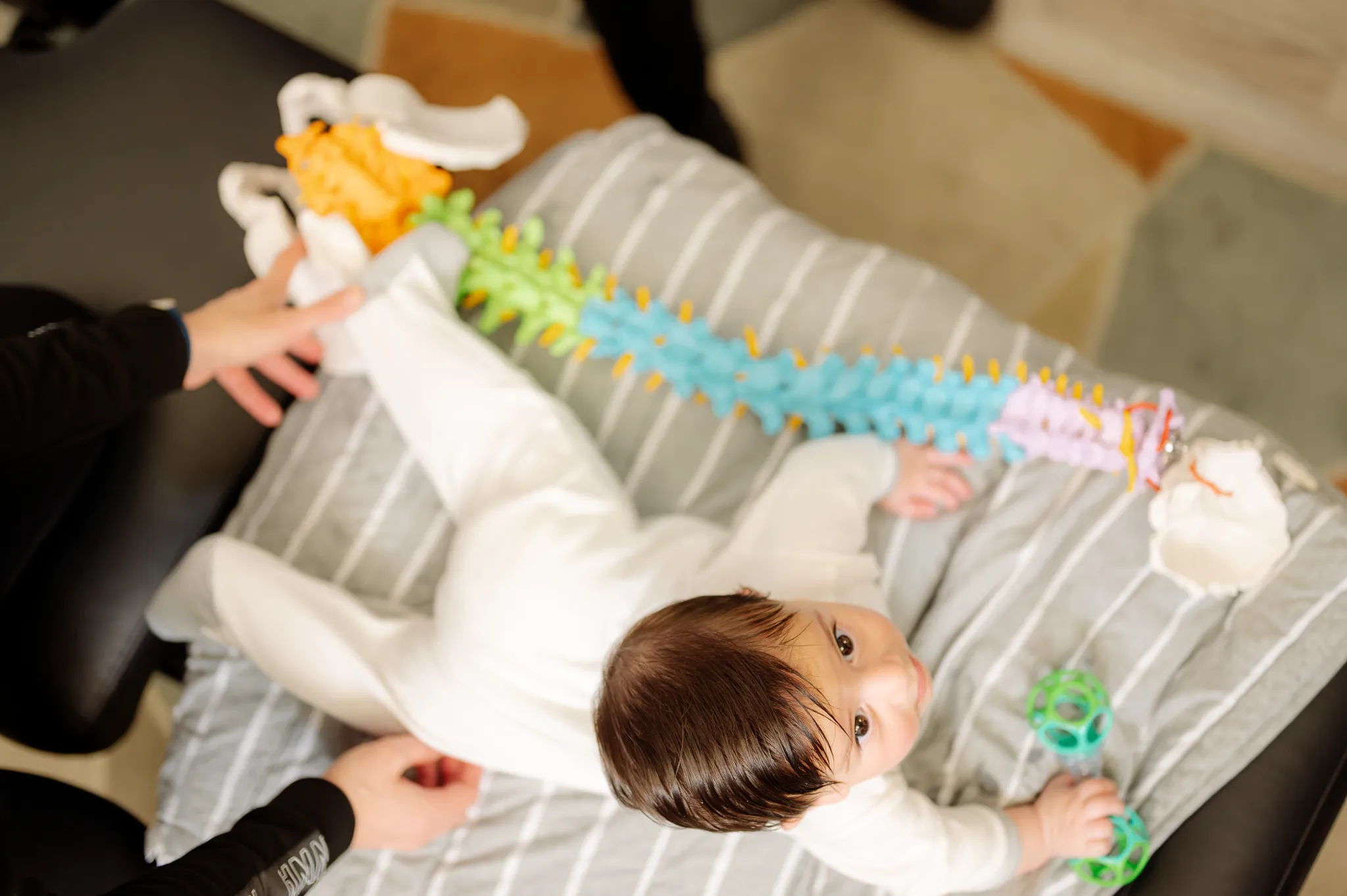
At District Wellness, a first visit for a school-age child starts with a full postural assessment — how the shoulders sit relative to each other, whether the pelvis is level, how the child walks and moves through basic ranges of motion. Dr. Hamidi checks for joint restriction in the thoracic spine, which is the most common area affected by backpack overload, and looks at muscle tone through the neck and upper back. Adjustments for children are far gentler than what an adult receives — lower force, shorter duration — and are always paired with simple home exercises a parent can supervise, like shoulder blade squeezes and doorway chest stretches that counteract the forward-rounded posture a heavy pack creates.
The American Academy of Orthopaedic Surgeons publishes backpack-weight guidance that echoes what pediatric chiropractors see clinically — this isn’t a fringe concern, it’s a documented pediatric musculoskeletal issue with decades of research behind it.
Common Questions
Should my child use a rolling backpack instead? For kids who genuinely have to carry heavy loads on certain days — instrument plus books, or sports gear plus a laptop — a rolling bag is a reasonable solution as long as the school allows it and the terrain isn’t all stairs. It’s not a substitute for reducing the load in the first place, though.
How do I know if it’s the backpack or something else causing my child’s back pain? That’s exactly what an evaluation sorts out. Growth-related pain, a prior injury, and mechanical strain from a heavy bag all present a little differently, and Dr. Hamidi will check for red flags that need a pediatrician referral versus mechanical issues chiropractic care can address directly.
Is it too late to fix posture habits that started last school year? No. Kids’ bodies are remarkably adaptable in the other direction too — with lighter loads, better packing habits, and a few months of corrective exercise, most postural compensation patterns from backpack overload resolve well.
Takeaway
A backpack that’s too heavy is one of the most common, most fixable sources of musculoskeletal strain in school-age kids, and it’s worth taking seriously before it becomes a habitual posture pattern rather than a seasonal complaint. If your child is showing any of the warning signs above, District Wellness offers evaluations built specifically for growing spines. Call (571) 568-8496 or visit /new-patient-scheduling to get your child assessed before the school year gets any heavier.