
Patients ask Dr. Hamidi this question constantly: if massage just relaxes muscles, how could it possibly do anything for back pain that’s been around for a year or more? It’s a fair question, and the honest answer is that massage therapy is not a standalone cure for chronic low back pain, but it is a legitimate, evidence-supported tool when it’s used the right way and combined with the rest of a treatment plan.
Massage therapists Jeff Fischer, Sawyer Smith, and Carla Thomas at District Wellness work with chronic back pain patients every week, and what they’ve learned matches what the research shows: massage changes how tissue behaves and how the nervous system perceives pain, and that combination can meaningfully reduce chronic pain when it’s paired with movement-based rehab rather than used alone.
What Chronic Back Pain Actually Is
Acute back pain, like a fresh muscle strain from lifting something wrong, usually has a clear tissue-level cause that heals in a predictable timeline. Chronic back pain - pain lasting more than three months - is different. By that point, the original injury has often healed, but the nervous system has become sensitized, surrounding muscles have developed compensatory tension patterns, and fear of movement has sometimes made the whole area stiffer and weaker than it needs to be. Treating chronic pain effectively means addressing all of that, not just the original tissue.
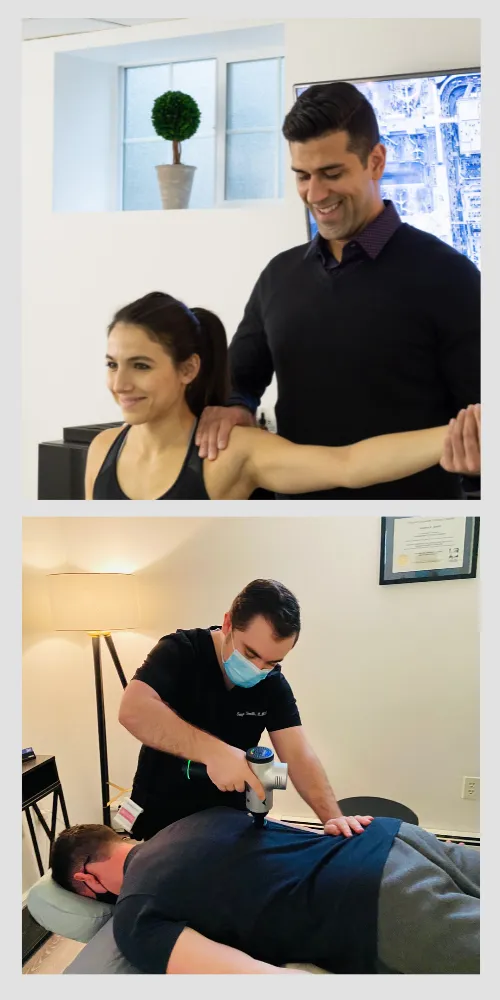
What Massage Does Physiologically
A few mechanisms are well documented:
- Reduces muscle tension and trigger points. Chronic pain almost always comes with protective muscle guarding - the paraspinal muscles, glutes, and hip flexors tighten up around a painful area. Deep tissue and trigger point work releases that guarding, which can reduce mechanical load on the spine.
- Improves local blood flow. Increased circulation to tight, poorly perfused tissue supports the removal of inflammatory byproducts and delivery of nutrients needed for tissue repair.
- Down-regulates the nervous system. Massage activates the parasympathetic nervous system, which can reduce the overall pain sensitivity that develops in chronic pain states. This is a real, measurable effect, not just relaxation in a vague sense.
- Improves range of motion, which makes the rehab exercises that actually build long-term resilience easier and less painful to perform.
Where Massage Alone Falls Short
Massage on its own tends to provide temporary relief that fades over days. That’s not a failure of the treatment, it’s a mismatch between the tool and the problem. Muscle tension that’s being driven by a misaligned joint, a disc issue, or poor movement patterns will keep coming back if only the muscle symptom is addressed. This is why Dr. Hamidi pairs massage with chiropractic evaluation and adjustment for back pain patients rather than sending everyone straight to the massage table.
How It Works Together at District Wellness
A typical chronic back pain plan looks like:
- Chiropractic assessment to identify joint restrictions, disc involvement, or nerve irritation such as sciatica
- Adjustment or mobilization to restore normal joint mechanics
- Massage therapy targeting the muscles that have been compensating around the restricted area
- Corrective exercise to build the strength and control that keeps the improvement from fading
Patients recovering from motor vehicle accidents often benefit from this combined approach as well, since whiplash and soft-tissue injuries from a crash frequently leave both joint restriction and chronic muscle guarding behind - covered in more detail in Dr. Hamidi’s article on motor vehicle accident injuries.
What the Research Says
Systematic reviews of massage therapy for chronic low back pain have generally found modest but real short- to medium-term improvements in pain and function compared to no treatment, particularly when combined with exercise. It’s not a miracle fix and shouldn’t be marketed as one, but as one part of a coordinated plan it earns its place.
Who Benefits Most
Massage therapy tends to help chronic back pain patients most when:
- Muscle guarding and tightness are a significant part of the pain picture, not just joint or disc pathology
- It’s scheduled consistently rather than as a one-time treatment
- It’s combined with corrective exercise between sessions
- Stress is a contributing factor, since the nervous system down-regulation effect compounds with reduced overall tension
Office workers in the Rosslyn-Ballston corridor who spend eight-plus hours a day seated are a common example - years of desk posture create chronic tension patterns in the low back and hips that respond well to a combined chiropractic and massage approach. Related reading covers this pattern in more depth in why your lower back hurts when you sit all day.
Common Questions
How often should I get massage for chronic back pain? Most patients start weekly or biweekly during an active treatment phase, then space out sessions as symptoms improve and maintenance becomes the goal.
Is deep tissue massage always better for chronic pain? Not necessarily. The right pressure depends on how sensitized the tissue is; sometimes lighter work is more effective early on, with deeper work introduced as tolerance improves.
Can massage replace chiropractic care? For most chronic back pain, no. They address different parts of the problem and work best together.
Dr. Hamidi has also written about non-drug approaches to pain more broadly in non-surgical pain relief at a chiropractor, which covers how these tools fit into a bigger picture beyond just back pain.
Takeaway
Massage therapy is a real, evidence-backed part of treating chronic back pain, but it works best as one piece of a coordinated plan rather than a standalone fix. If chronic back pain has been dragging on and you’re not sure what combination of care actually makes sense for your situation, District Wellness can build a plan around your specific pattern. Call (571) 568-8496 or schedule through new patient scheduling.